
An explosion at a firecracker factory in Madhya Pradesh's Dewas district resulted in multiple fatalities and injuries, prompting investigations and government action.
India has gained the least since Russia invaded Ukraine in February 2022 and was penalised the most, while the US, China and the European Union emerged as the biggest beneficiaries from the war.

Today's situation in the Shaksgam Valley is the consequence of what happened in Gilgit in 1947. But is India ready to militarily get back its territories? asks Claude Arpi.

Apple CEO Tim Cook expresses strong optimism about the Indian market, citing its potential for growth and the company's recent successes in the region.

There are enough people at the top decision-making level in Tehran who are still willing to negotiate, provided Trump can create the right setting for the negotiation to acquire a dynamic of its own, points out Ambassador M K Bhadrakumar.

'Even last year, when India bought gold, the physical quantity was much less than the previous years.'

US President Donald Trump threatened to bomb Iran if a deal is not reached before the ceasefire ends, while Pakistan urged both sides to extend the truce and pursue diplomacy.

The Indian and Chinese militaries held a fresh round of high-level military talks focusing on maintaining peace and security along the Line of Actual Control (LAC) in eastern Ladakh.
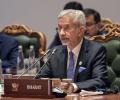
India has expressed serious concerns about the West Asia crisis and its potential impact on energy supplies and maritime stability, urging BRICS nations to find practical solutions to geopolitical challenges and unilateral sanctions.

'Nepal today is far more aware, self-confident, aspirational, and assertive.' 'India's policy so far has not been geared to this shift. It is time to redraw our Nepal strategy.'
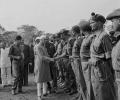
The well-fought defensive battles in Aksai Chin and eastern Arunachal, in remote and forbidding locations such as Galwan, Rezang La, Gurung Hill and Walong, effectively halted Chinese advances not once but twice during the campaign. These engagements, fought with grit and without adequate support, were not immediately known to the world in 1962, points out Dr Kumar.

The intriguing bit is that Trump is likely to attend the talks in Islamabad this weekend -- if he does, it will be the clearest signal yet that the US is ready to exit the war with some sort of win to show, since he cannot afford to go for the talks and return empty-handed, notes Prem Panicker in his must read blog on the Iran War

Pakistan's Foreign Office has refuted media reports suggesting that its efforts to facilitate peace talks between the US and Iran have stalled, calling the reports baseless and speculative.

R Praggnanandhaa leads a fearless new generation at the Candidates 2026 as veterans face a shifting chess landscape ahead of a world title clash.

India should simultaneously prioritise domestic exploration and production of more oil and gas in the country, and ensure we retain diversified suppliers for imports, points out former foreign secretary Ranjan Mathai.

The LPG squeeze on India's restaurant sector is the quotidian face of a deeper crisis.

'However, we must implement a tit-for-tat approach -- reciprocating their conduct with precision.' 'If they demonstrate respect, we respond accordingly. If they adopt hostile positions, we mirror that hostility with equal intensity.'

'We need to give Pakistan something serious to think about on its eastern front -- that is the only way to actually help Afghanistan right now.'

It may now be time to question the price India is paying for Israel's disregard of the serious undermining of India's energy security, asserts former foreign secretary Shyam Saran.

US President Donald Trump indicated the possibility of further military operations against Iran's Kharg Island, a key oil export hub, claiming previous strikes had significantly damaged its infrastructure.

The ceasefire is still technically holding, to the extent that no overt hostilities have been reported yet, but the rhetoric has hardened dangerously. The week ahead will also clarify whether the Islamabad failure was a negotiating tactic or whether Washington has genuinely locked itself into a position from which the only exits are climb-down, escalation, or the slow bleed of a new status quo that nobody chose and nobody controls. Prem Panicker continues his must read blog on the Iran War.

India should resist knee-jerk responses to tariff volatility in the US and instead use the current geopolitical churn to build manufacturing scale at home, former G20 Sherpa and former chief executive officer of NITI Aayog Amitabh Kant said on Wednesday.

'No, India and China were not about to go to all-out war over a few rocks of Galwan.' 'The full picture of what went on at the highest level between two heads of State will not be known for a very, very long time and rightly so,' points out Colonel Anil A Athale, former head of the history division, ministry of defence.

The clock on the ceasefire is running out. But everyone's already whispering about round two, possibly as soon as this weekend.
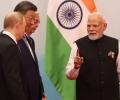
Bolton slammed Trump's tariff policy, asserting that it has "shredded" decades of Western efforts to align India away from its Cold War ties with the then Soviet Union (Russia) and address the growing threat from China.

West Asia conflict triggers sharp sell-off in Indian markets, with realty, banking and auto stocks leading losses amid energy shock fears.

'As the PLA higher command is almost dismantled and instability spreads, India needs to be prepared for any eventuality,' cautions China expert Srikanth Kondapalli.

The stock and bond markets told Trump firmly that any idea of isolating China would lead to harming the US economy and this forced Trump to backtrack, points out Aakar Patel.

'Was the five-day pause ever meant to hold, or was it simply another instrument of signaling, of positioning, of buying time in a war where even the pauses are tactical?' asks Prem Panicker in his must read daily blog on the Gulf War.
'What's currently underway is not a 'reset'.' 'What needs to be arrived at is a new balance.'
Former US National Security Advisor John Bolton says President Trump's policies have damaged US-India relations, pushing New Delhi closer to Russia and China.

'Our diplomacy should have been focused on preventing war and avoiding the inevitable disruptions it would cause, posing a real risk to India's growth story,' asserts former foreign secretary Shyam Saran.
The new US national security strategy signals a retreat from global dominance while reaffirming continuity in India's role in Indo-Pacific security and Quad cooperation, points out former foreign secretary Shyam Saran.

If Xi Jinping can establish control over the PLA Ground Force, relations between India and China will settle down to an even keel. The next few weeks will show whether Xi has finally succeeded in gaining control over the PLA Ground Force. That could bring about the substantive shift in India-China relations that both our leaders have been working for, observes Ambassador Prabhat Shukla.

'If Washington has to balance Chinese power, she will have to turn to the third biggest power in the world which is India.' 'The United States and India will have to work together in order to keep Chinese ambitions in check.'

Amid escalating tensions with Iran, President Trump is urging nations dependent on Middle Eastern oil to deploy warships to the Strait of Hormuz to safeguard critical global energy supplies.

China appears determined to upgrade Pakistan's military capabilities, sufficient to ensure local parity with India, alerts former foreign secretary Ambassador Shyam Saran.

It's time India re-visited its Western alliances for the attitude and approach that the West reserves for the nation when it comes to security cooperation of the kind that they might not have visualised outside of China, India's bug-bear, asserts N Sathiya Moorthy.

'Without ground troops the US will not be able to oust the Iranian Islamic regime. Political change does not happen just by using bombs or planes.'
The relations between New Delhi and Washington are on a downturn after Trump doubled tariffs on Indian goods to a whopping 50 per cent, including a 25 per cent additional duties for India's purchase of Russian crude oil.
